Updated on October 17, 2026 · Our editorial process
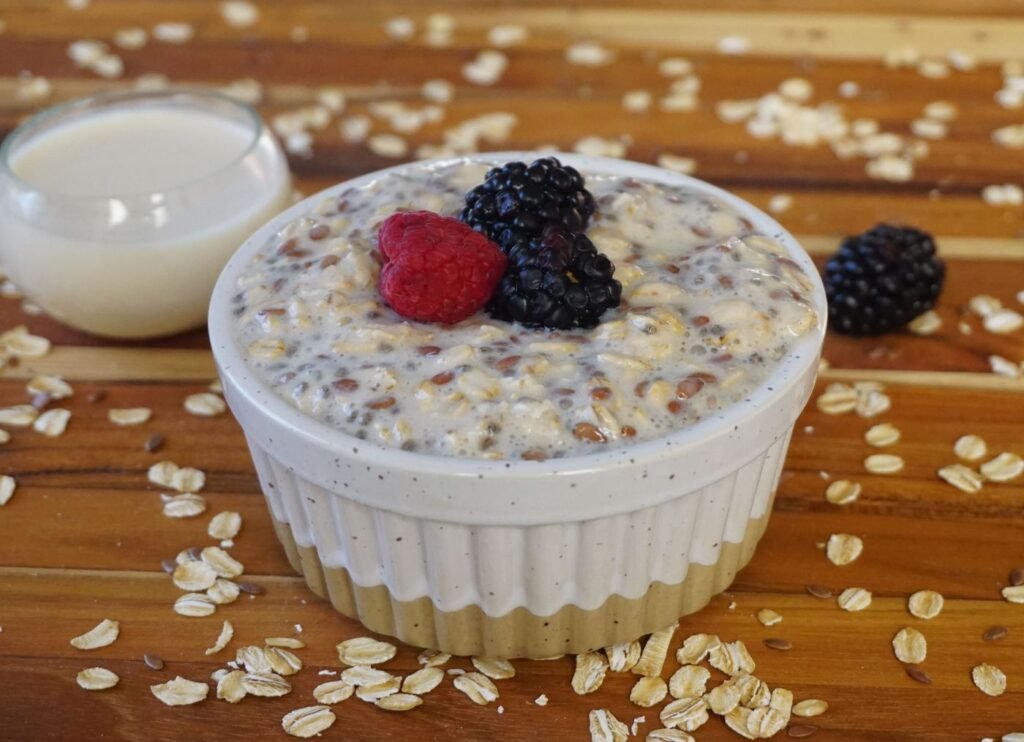
Overnight oats are the breakfast you make while half asleep the night before, so that the next morning you only have to open the fridge. There is no cooking. You stir oats into milk, leave the jar in the fridge, and by morning the oats have softened into something between porridge and pudding.
This guide gives you a base recipe that works every time, the one ratio you need to remember, how long the oats keep, what is actually in a serving, and five variations that stay healthy rather than turning breakfast into dessert. It also covers the mistakes that make overnight oats watery, gluey or bland, because most first attempts go wrong for the same three reasons.
Key takeaways
- The ratio is one to one: equal amounts of rolled oats and milk by volume. Add a spoon of chia seeds for a thicker, creamier result.
- Use old-fashioned rolled oats. Instant oats go mushy and steel-cut oats stay hard unless you soak them for two nights.
- Soak for at least four hours. Overnight is best. They keep in the fridge for three to four days in a sealed jar.
- A basic serving gives roughly 280 calories, 12 grams of protein and 9 grams of fibre, with no added sugar if you sweeten it with fruit.
Why overnight oats work
Cooking oats uses heat to break down their starch so they soften. Soaking does the same job slowly. Rolled oats have already been steamed and flattened during processing, so they take up liquid easily and are fully soft after a night in the fridge. Harvard’s Nutrition Source notes that the mixture thickens into a pudding-like texture, and recommends old-fashioned or rolled oats rather than instant for exactly this reason.
The type of oat matters more than anything else in the recipe:
- Rolled oats, also sold as old-fashioned oats, are the right choice. They soften fully and keep a little bite.
- Quick and instant oats are rolled thinner and cut smaller so they cook in minutes. Overnight they turn to paste.
- Steel-cut oats are whole groats chopped into pieces, with no steaming. They need at least two nights of soaking and stay chewy even then.
How to make overnight oats: the base recipe
This makes one serving. Scale it up by multiplying everything. A 350 ml or 12 oz jar with a lid is the ideal container, because you can mix, store and eat from the same jar.
Ingredients
- 1/2 cup rolled oats (about 40 g)
- 1/2 cup milk of your choice (about 120 ml). Dairy, soy, oat and almond milk all work.
- 1 tablespoon chia seeds (about 14 g), optional but recommended
- 1 to 2 tablespoons plain yoghurt, optional, for a creamier texture
- A pinch of salt
- 1/2 teaspoon vanilla extract or 1/2 teaspoon ground cinnamon, optional
- Sweetener to taste: 1 teaspoon honey or maple syrup, or half a mashed banana
Method
- Put the oats, chia seeds and salt in the jar and stir so the chia is spread through the oats. Clumps of chia turn into jelly lumps, so this stir matters.
- Add the milk, yoghurt, vanilla or cinnamon, and sweetener. Stir well, scraping the bottom of the jar.
- Put the lid on and refrigerate for at least 4 hours. Overnight, around 8 hours, gives the best texture.
- In the morning, stir again. If it is thicker than you like, add a splash of milk. Top with fruit, nuts or seeds and eat cold, or warm it in the microwave for 60 to 90 seconds.
The one ratio to remember: one part oats to one part milk by volume. Quaker’s own method uses the same one-to-one ratio and recommends a full eight hours in the fridge. If you add chia seeds, which absorb up to ten times their weight in liquid, add an extra tablespoon or two of milk so the oats do not come out dry.
How long to soak, and how long they keep
Four hours is the minimum for rolled oats. If you make them at 7 am for an 11 am snack, they will be ready. Most sources, including Harvard and Quaker, give overnight as the ideal. Longer than 24 hours and the oats start to lose their texture, though they are still safe to eat.
For storage, treat overnight oats like any cooked food. The US Department of Agriculture gives three to four days in the fridge for leftovers, and that is a sensible limit for oats made with milk. Keep the fridge at or below 4 C (40 F), which is the FDA’s recommended setting, and do not leave the jar out at room temperature for more than two hours. If you add banana, eat the oats within two days because the fruit browns and softens quickly.
This is why overnight oats work so well for meal prep. Make four jars on Sunday evening and breakfast is done until Thursday. Freezing is not recommended. The texture turns watery and grainy after thawing.
What is in a serving
These figures are for the base recipe made with 40 g rolled oats, 120 ml semi-skimmed (2 percent) milk and 14 g chia seeds, with no sweetener. They are calculated from USDA FoodData Central values and rounded, so treat them as a close estimate rather than a lab result.
| Nutrient | Per serving, approx. | Where it comes from |
|---|---|---|
| Calories | 280 kcal | Oats 150, milk 60, chia 70 |
| Protein | 12 g | Oats 5 g, milk 4 g, chia 2 g |
| Fat | 9 g | Mostly unsaturated, from chia and oats |
| Carbohydrate | 38 g | Oats |
| Fibre | 9 g | Oats 4 g, chia 5 g |
| Sugars | 6 g | All natural milk sugar, no free sugars |
| Calcium | 240 mg | Milk and chia |
| Iron | 2.8 mg | Oats and chia |
Nine grams of fibre is almost a third of the 30 grams a day the NHS recommends, from a single breakfast. Most adults manage only around 20 grams a day, so this one jar closes a lot of the gap. Adding fruit on top pushes it higher.
Twelve grams of protein is decent but not high. If you want a breakfast that keeps you full until lunch, add 100 g of plain Greek yoghurt, which brings roughly 10 g more protein, or two tablespoons of peanut butter for about 7 g.
Why oats are worth eating every day
They lower cholesterol
Oats contain a soluble fibre called beta-glucan, and it is one of the few food components with a health claim approved by regulators on both sides of the Atlantic. The US Food and Drug Administration and the European Union both allow oat products to say that 3 grams of beta-glucan a day can help lower blood cholesterol. A review of 28 controlled trials found that this amount lowered LDL cholesterol, the harmful kind, by about 0.25 mmol/L, roughly 5 to 7 percent for a typical adult, without affecting the protective HDL kind.
A half cup of rolled oats provides about 2 grams of soluble fibre, so the base recipe gets you two thirds of the way to the daily amount. A slightly larger serving, or a second oat-based meal in the day, covers it.
They keep you full
Beta-glucan forms a gel in the stomach that slows digestion. In a crossover trial, adults who ate oatmeal reported more fullness and less hunger than after an oat-based boxed cereal with the same calories, and they ate less at lunch. One caution: that study was partly funded by an oat company, so it is best read alongside the wider evidence. Harvard’s summary is that oats reliably increase fullness, but trials have not consistently shown that this leads to weight loss on its own.
They are gentle on blood sugar
Less processed oats have a lower glycaemic index than instant oats, meaning a slower rise in blood sugar after eating. Harvard cites a review of 14 trials in which oats reduced fasting blood glucose and HbA1c, a measure of average blood sugar, in people with type 2 diabetes. Overnight oats made with rolled oats, no syrup and fruit for sweetness are a reasonable choice for anyone watching their blood sugar, though people with diabetes should fit them into their own meal plan.
Soaking helps a little with minerals
Oats, like all whole grains, contain phytic acid, which binds to iron, zinc and calcium so that a little less is absorbed. Harvard notes that soaking overnight breaks some of it down, which is a small bonus of this method. It also notes that on a varied diet this is not something to worry about, and that phytates have antioxidant properties of their own. Overnight oats are not a mineral supplement, but they are not robbing you of anything either.
5 healthy variations
Each of these starts with the base recipe. Add the extras at the mixing stage unless the note says to add them in the morning.
1. Peanut butter and banana
Stir 1 tablespoon of peanut butter into the milk before adding it, then mash half a banana into the mix. A medium banana brings about 450 mg of potassium and 3 g of fibre, and peanut butter adds protein and healthy fat. Choose a peanut butter with no added sugar or palm oil. Eat within two days because of the banana.
2. Apple and cinnamon
Grate half an apple with the skin on and stir it in with 1/2 teaspoon of cinnamon. The skin holds most of the apple’s fibre, so do not peel it. A squeeze of lemon juice stops the apple browning. Cinnamon is there for flavour. Claims that it controls blood sugar are not well supported, and the National Center for Complementary and Integrative Health notes that large amounts of the common cassia type can be a problem for people with liver disease, so stick to normal food amounts.
3. Berry and Greek yoghurt
Swap the optional yoghurt for 100 g of plain Greek yoghurt and reduce the milk slightly, then add a handful of blueberries or mixed berries in the morning. This is the high-protein version, at around 22 g per jar. A cup of blueberries adds fibre and vitamin C for very few calories. Avoid flavoured yoghurts, which can contain 20 g or more of sugar in a small pot.
4. Chocolate
Add 1 tablespoon of unsweetened cocoa powder and an extra teaspoon of sweetener. Choose natural cocoa rather than Dutch-processed where you can. Harvard explains that the alkali used in Dutch processing removes much of the flavanols, the plant compounds linked to better blood flow. A tablespoon of cocoa also adds a surprising amount of fibre and iron. Top with sliced strawberries.
5. Carrot cake
Stir in 1/4 cup of finely grated carrot, 1/2 teaspoon of cinnamon, a pinch of nutmeg and a tablespoon of raisins. Top with chopped walnuts in the morning. Carrots are one of the richest food sources of beta-carotene, which the body turns into vitamin A. It tastes like dessert and has the nutrition of a vegetable side.
Mistakes that ruin overnight oats
- Wrong ratio. Too little milk gives a dry, stiff jar. Too much gives oat soup. Measure both the first few times until you can eyeball it.
- Wrong oats. Instant oats go to mush and steel-cut oats stay raw. Rolled oats only.
- No salt. A pinch of salt makes oats taste like oats instead of wet cardboard. It is the most skipped step and the most noticeable.
- Chia clumps. Stir the chia into the dry oats before the milk goes in, and stir once more after ten minutes if you can.
- Fruit that browns. Apple, banana and pear turn brown through an enzyme reaction with air. A little lemon juice slows it down, or add these fruits in the morning.
- Too much sugar. Honey, maple syrup and agave all count as free sugars, and the NHS limit for adults is 30 g a day. One teaspoon of syrup is about 5 g. Sweeten with fruit where you can.
- Not stirring before eating. The liquid settles at the bottom overnight. One good stir fixes the texture.
A note on gluten
Oats do not contain gluten, but they are usually grown, transported and milled alongside wheat and barley, so ordinary oats are often contaminated. If you have coeliac disease, Coeliac UK advises using only oats labelled gluten-free, which are tested to contain no more than 20 parts per million. A label that says “pure oats” or “100 percent oats” is not the same thing. Oats also contain a protein called avenin that a very small number of people with coeliac disease react to, so if you are newly diagnosed, introduce oats with your dietitian’s guidance.
The bottom line
Equal parts rolled oats and milk, a spoon of chia, a pinch of salt, and at least four hours in the fridge. That is the whole recipe. It gives you a breakfast with around 280 calories, 12 g of protein and 9 g of fibre, no added sugar, and five minutes of effort the night before.
Make a few jars at once, change the flavour each day so you do not get bored, and keep the sweetener to a teaspoon or swap it for fruit. For more simple, healthy meals, see our Recipes section.
Frequently asked questions
What is the ratio of oats to milk for overnight oats?
One to one by volume. Use 1/2 cup of rolled oats to 1/2 cup of milk for one serving. If you add a tablespoon of chia seeds, add an extra tablespoon or two of milk, because chia absorbs a lot of liquid. If you prefer a looser texture, add a splash more milk in the morning rather than the night before.
How long do overnight oats need to soak?
At least four hours for rolled oats. Overnight, around eight hours, gives the best texture. Steel-cut oats need two nights and still stay chewy. Instant oats are not recommended because they turn to paste in under an hour.
How long do overnight oats last in the fridge?
Three to four days in a sealed jar at or below 4 C (40 F), which matches US government guidance for cooked leftovers. If the recipe includes banana or another soft fruit, eat it within two days. Do not leave the jar out of the fridge for more than two hours. Freezing is not recommended because the texture becomes watery after thawing.
Are overnight oats healthy?
Yes, if you keep the sweetener small. A basic serving has about 280 calories, 12 g of protein and 9 g of fibre, nearly a third of the daily fibre target. The soluble fibre in oats, beta-glucan, has an approved health claim for lowering cholesterol at 3 g a day, and oats increase fullness more than most boxed cereals. The main way overnight oats stop being healthy is by adding several spoons of syrup, flavoured yoghurt or chocolate chips.
Can I eat overnight oats warm?
Yes. Microwave the jar without the lid for 60 to 90 seconds, stir, and add a splash of milk if it has thickened. Warming does not change the nutrition. Some people prefer them warm in winter and cold in summer.
Can I make overnight oats with water instead of milk?
You can, and the oats will soften the same way, but you lose the protein and calcium that milk adds and the result tastes flatter. If you want to avoid dairy, soy milk gives the closest protein content, and oat or almond milk work well for texture. Adding yoghurt or chia helps make up for the thinner liquid.
Are overnight oats gluten-free?
Only if you buy oats labelled gluten-free. Oats themselves do not contain gluten, but ordinary oats are usually contaminated with wheat or barley during growing and processing. People with coeliac disease should use certified gluten-free oats, and a small number also react to avenin, a protein in oats, so check with a dietitian when first adding them.